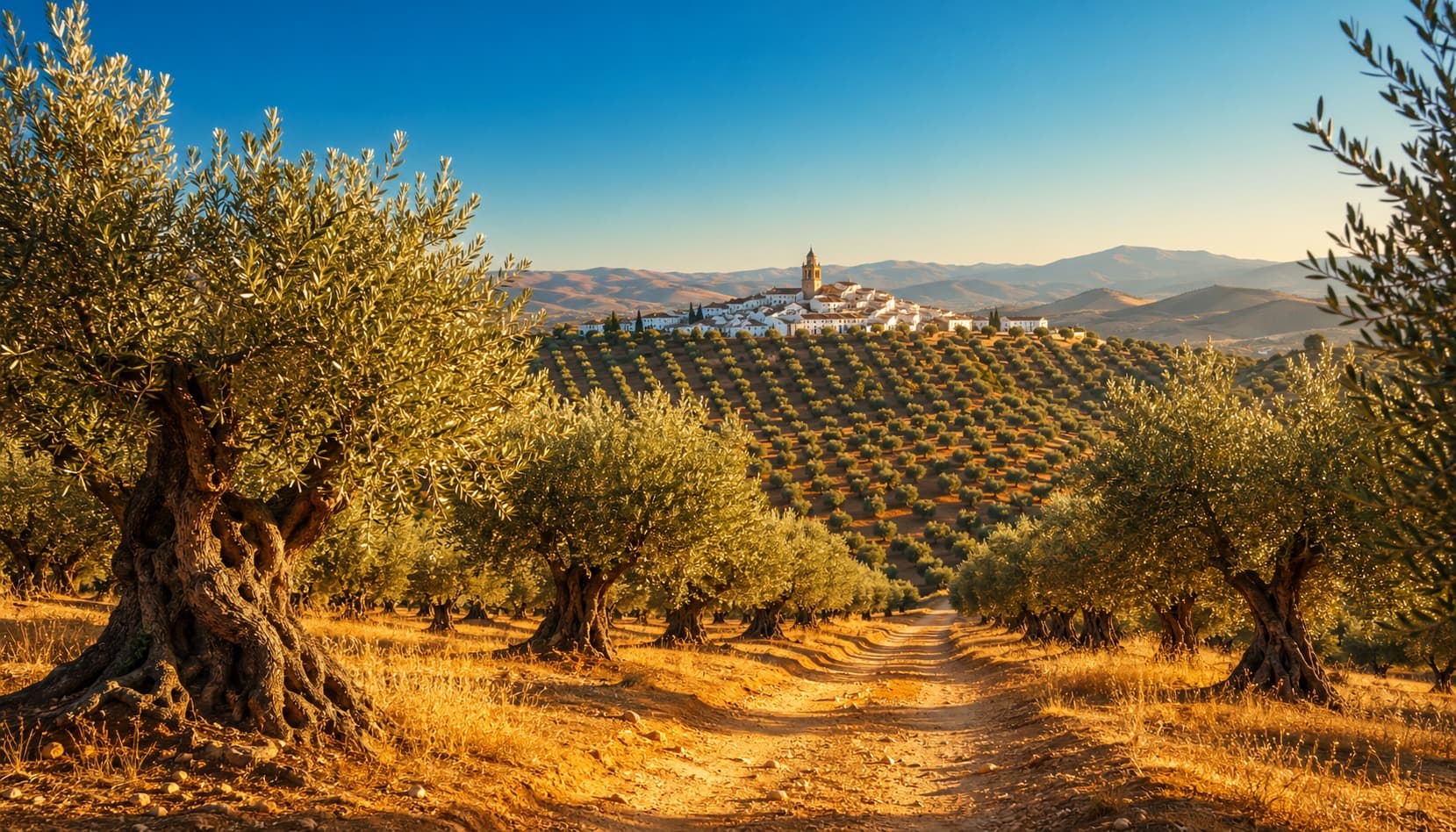
Camino Mozárabe
390km pilgrimage route in Spain
Distance
390km
Duration
16 days
Difficulty
Moderate
Certification
Compostela (via Vía de la Plata)
Start → End
Granada → Mérida
Planning Snapshot
Distance
390km
Typical duration
16 days
Average day
24.4km/day
Difficulty
Moderate
Best months
March–June, September–November
Lodging density
low
Resupply
hard
Access
Fly into Granada (GRX) or Málaga (AGP), then bus or train to Granada city centre to start.
Is this route a good fit?
Best for
Moorish history & heat
Time commitment
16 walking days at about 24.4km/day
Lodging and resupply
low lodging · hard resupply
Why use Sacred Trails
Offline stages, waypoint stories, lodging notes, and route context stay available when mobile signal drops.
Rough Distance Planner
Use this as a rough distance sketch before detailed planning: 16 walking days across 390km, averaging about 24.4km per day. Adjust for real stages, terrain, rest days, weather, opening seasons, and lodging availability before booking.
Total days
16
Average walking day
24.4km
Route style
low lodging · hard resupply
1
Walk
Granada → Pinos Puente
Granada · 4 listed stays
24.4km
24.4km
2
Walk
Pinos Puente → Moclín
Pinos Puente · 1 listed stays
24.4km
48.8km
3
Walk
Moclín → Alcalá la Real
Mures · 1 listed stays
24.4km
73.2km
4
Walk
Alcalá la Real → Alcaudete
Alcalá la Real · 1 listed stays
24.4km
97.6km
5
Walk
Alcaudete → Baena
Castro del Río · 2 listed stays
24.4km
122km
6
Walk
Baena → Espejo
Espejo · 1 listed stays
24.4km
146.4km
7
Walk
Espejo
Villaharta · 1 listed stays
24.4km
170.8km
8
Walk
Espejo → Córdoba
Alcaracejos · 1 listed stays
24.4km
195.2km
9
Walk
Córdoba → Almodóvar del Río
Villanueva del Duque · 1 listed stays
24.4km
219.6km
10
Walk
Almodóvar del Río → Villa del Río
Hinojosa del Duque · 1 listed stays
24.3km
243.9km
11
Walk
Villa del Río → Montoro
Castuera · 1 listed stays
24.3km
268.2km
12
Walk
Montoro → Andújar
Campanario · 2 listed stays
24.4km
292.6km
13
Walk
Andújar
La Haba · 1 listed stays
24.3km
316.9km
14
Walk
Andújar → Bailén
Don Benito · 1 listed stays
24.4km
341.3km
15
Walk
Bailén → Aldeaquemada
Trujillanos · 1 listed stays
24.3km
365.6km
16
Walk
Aldeaquemada → Mérida
Mérida · 1 listed stays
24.4km
390km
Distances are averaged. Route markers use the nearest ordered waypoint to each rough segment; lodging references are supporting town data, not recommended overnight stops or confirmed availability.
About the Route
The Camino Mozárabe rises from the foot of the Sierra Nevada in Granada, a city where the last whispers of Moorish Andalusia still echo in the halls of the Alhambra, and carries those whispers northward across one of Europe's most layered landscapes. For centuries, the Mozarabs — Christians who lived and prayed under Islamic rule — travelled this road in secret devotion, navigating a land of orange groves, Roman aqueducts, and whitewashed villages that stood at the crossroads of two great civilizations. The route unfurls through the vast heat of Extremadura before joining the ancient Via de la Plata at Mérida, where a Roman bridge nearly two thousand years old still spans the Guadiana River. To walk the Mozárabe is to carry within you the weight of coexistence — of faith persisting across conquest, and of a Spain that was, for a brief golden age, both Islamic and Christian at once.
Key Waypoints
Granada
0km from start · 738mGranada was the last Nasrid capital, held by the Moorish dynasty until 2 January 1492, the date the Catholic Monarchs entered the Alhambra and ended eight centuries of Muslim rule in Iberia. The Cathedral was built from 1523 directly over the Great Mosque, and the Mozarabic route is named for the Christian communities — the Mozarabs — who preserved Latin Christian rites under Moorish rule and walked north to Compostela before the Reconquista was complete.
Moclín
35km from start · 860mMoclín's hilltop castle was the Moors' last major frontier fortress before Granada, its walls built in the 13th century and captured by the Catholic Monarchs in 1486 after a six-year siege campaign. Inside the fortress walls stands the Sanctuary of Cristo del Paño, which preserves a medieval cloth relic of Christ's face — traditionally brought here by the conquering troops after 1486 — that draws pilgrims on a separate annual romería each October.
Alcaudete
96km from start · 743mAlcaudete's castle was held by the Military Order of Calatrava from 1340, awarded to the Order after Alfonso XI's conquest — one of its most important frontier strongholds against the Nasrid kingdom of Granada. The Church of Santa María Mayor, built in the 16th century within the former mosque quarter, preserves a Gothic portal and a Baroque tower; a second church, San Pedro, retains a Mudéjar nave from the original Reconquista-era construction.
Espejo
156km from start · 374mEspejo's castle belonged to the Counts of Cabra from the 15th century — the same Alfonso de Aguilar family whose cousin Gonzalo de Córdoba became the Great Captain who revolutionised European warfare in Italy. The parish church of San Bartolomé, built over the former mosque, preserves a 16th-century retablo attributed to the workshop of Bartolomé de Jaén; the castle tower's reflecting-pool legend gave the village its name, which means 'mirror' in Spanish.
Almodóvar del Río
212km from start · 123mAlmodóvar's castle bears a name that reveals its layered history: the Arabic Hisn al-Mudawwar ('the round fortress') built over a Roman stronghold, taken by the Moors in 740 and rebuilt in its current eight-tower form by Alfonso XI of Castile in the 14th century. The Guadalquivir crossing here was controlled by the castle's garrison from Roman times; pilgrims passed beneath its walls on the ancient road from Córdoba toward Extremadura.
Montoro
270km from start · 196mMontoro was the Roman city of Epora, and its medieval bridge over the Guadalquivir — built in the 13th century on Roman foundations — was a key river crossing for the pilgrimage road north. The Church of San Bartolomé, whose Mudéjar tower rises above the red sandstone cliffs, contains a 16th-century painted retablo by Pablo de Céspedes, the artist-priest of Córdoba who also worked alongside Annibale Carracci in Rome.
Bailén
338km from start · 349mBailén is a historic crossroads town in Jaén province, famous for the 1808 Battle of Bailén where Spanish forces defeated Napoleon's army. The town marks the transition from Andalusia's olive-rich lowlands into the higher meseta plateau as the route continues north.
Aldeaquemada
365km from start · 620mAldeaquemada lies within the Despeñaperros Natural Park, one of the most dramatic mountain passes in Spain, where the route crosses the Sierra Morena into La Mancha. The gorge of the Despeñaperros has historically been the gateway between Andalusia and the central meseta.
16 waypoints total · Sacred Trails app contains full detail for every waypoint.
Points of Interest
Alhambra Palace
· monumentUNESCO World Heritage site and one of the finest examples of Moorish architecture in the world. Built by the Nasrid dynasty, the Alhambra complex includes royal palaces, gardens, and the Generalife summer residence. An iconic starting symbol for pilgrims beginning the Mozarabic Way.
Cathedral of Granada
· churchThe official starting point of the Camino Mozárabe, where pilgrims receive their credential (pilgrim passport). Built on the site of the former Great Mosque of Granada, the cathedral blends Gothic and Renaissance styles. The Pilgrims' Office here is essential for officially beginning the pilgrimage.
Fortaleza de la Mota
· castleA hilltop fortress complex in Alcalá la Real combining a Moorish citadel, a Gothic church, and panoramic views. Once a key military stronghold on the frontier between Christian and Moorish kingdoms, it was used as a gateway to Granada by Mozarab Christians centuries before the Reconquista was complete.
Castle of Alcaudete
· castleA well-preserved Moorish castle overlooking the town of Alcaudete, with towers and battlements dating to the 12th century. The castle changed hands multiple times during the Reconquista and became a base for the Order of Calatrava. Pilgrims can see it from the town centre on approach.
Mezquita-Catedral de Córdoba
· mosqueOne of the greatest masterpieces of Moorish architecture and a UNESCO World Heritage site. Originally a Visigothic church, expanded into a grand mosque by the Umayyad rulers, then converted to a cathedral after the Reconquista. The forest of double-tiered arches in red and white is unforgettable. A defining highlight of the entire Camino Mozárabe.
Alcázar de los Reyes Cristianos
· castleA 14th-century fortress palace built by King Alfonso XI of Castile, adjacent to the Mosque-Cathedral. Served as a royal residence for the Catholic Monarchs Ferdinand and Isabella during the final campaign of the Reconquista. Known for its magnificent gardens with fountains and pools, and its Roman mosaics collection.
Accommodation
Town lodging summary
28 listed staysCórdoba
4 stays
Rates vary; record your own price notes.
Granada
4 stays
Rates vary; record your own price notes.
Campanario
2 stays
Rates vary; record your own price notes.
Castro del Río
2 stays
Rates vary; record your own price notes.
Alcalá la Real
1 stay
Rates vary; record your own price notes.
Alcaracejos
1 stay
Rates vary; record your own price notes.
Castuera
1 stay
Rates vary; record your own price notes.
Don Benito
1 stay
Rates vary; record your own price notes.
Albergue del Monasterio de San Bernardo
Granada
Rate varies
Albergue Inturjoven Granada
Granada
Rate varies
4U Hostel
Granada
Rate varies
Granada Old Town Hostel
Granada
Rate varies
Albergue de peregrinos de Pinos Puente
Pinos Puente
Rate varies
Albergue-Casa rural La Fundación
Moclín
Rate varies
Open Mind Hostel
Mures
Rate varies
Acogida al Peregrino Casa Marisa
Alcalá la Real
Rate varies
Camino / Gronze
Source reference
Camino accommodation entries are compiled from Gronze-oriented route research as planning references, not live inventory or an affiliated booking feed. Rates are traveler-owned notes because they change by season and operator; confirm availability directly before departure.
Showing 8 of 28 · Rates vary; use your own price notes and verify availability directly before your trip.
⚠️ Before You Go
Best avoid
June–August (extreme heat in Andalucía and the Extremadura plains — temperatures exceed 40°C)
Weather risk
Summer heat is the primary risk; carry 3+ litres of water per stage in southern sections
Cash
Rural Extremadura villages have limited ATM access — carry €50+
Note
Extreme summer heat makes this route dangerous June–August; spring (March–May) is the optimal window
Recommended to carry
Navigate the Camino Mozárabe Offline
Stage-by-stage navigation, waypoint history, and lodging data — all offline in Sacred Trails. Free to download with route packs for the trails you walk.