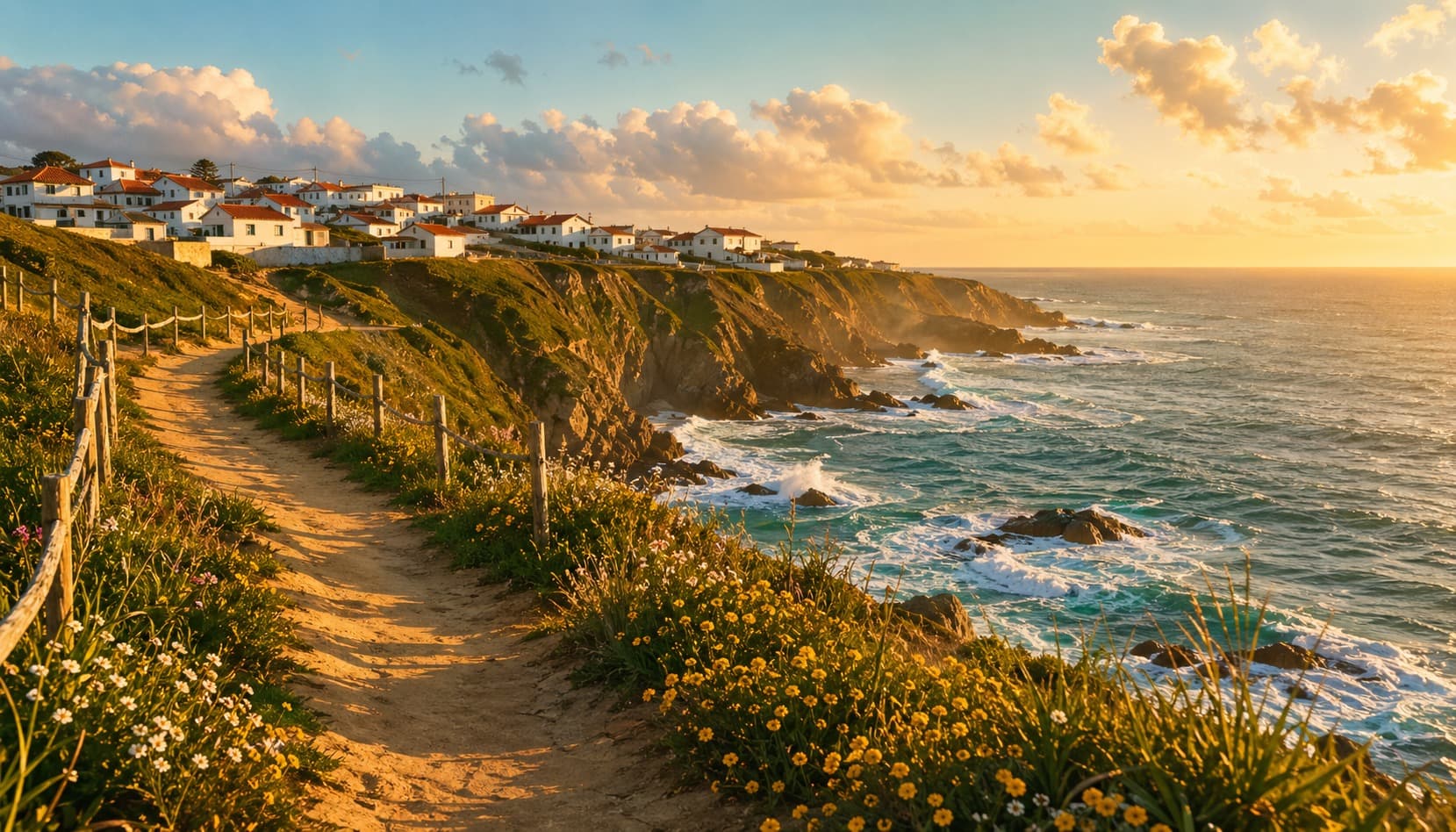
Camino Portugués Coastal
280km pilgrimage route in Portugal and Spain
Distance
280km
Duration
13 days
Difficulty
Moderate
Certification
Compostela
Start → End
Porto → Santiago de Compostela
Planning Snapshot
Distance
280km
Typical duration
13 days
Average day
21.5km/day
Difficulty
Moderate
Best months
April–June, September–October
Certificate minimum
100km walking
Lodging density
high
Resupply
easy
Access
Fly to Porto Airport (OPO), then walk or take metro to city centre to start.
Is this route a good fit?
Best for
Sea views & flat terrain
Time commitment
13 walking days at about 21.5km/day
Lodging and resupply
high lodging · easy resupply
Why use Sacred Trails
Offline stages, waypoint stories, lodging notes, and route context stay available when mobile signal drops.
Rough Distance Planner
Use this as a rough distance sketch before detailed planning: 13 walking days across 280km, averaging about 21.5km per day. Adjust for real stages, terrain, rest days, weather, opening seasons, and lodging availability before booking.
Total days
13
Average walking day
21.5km
Route style
high lodging · easy resupply
1
Walk
Porto → Angeiras
Porto · 7 listed stays
21.5km
21.5km
2
Walk
Angeiras → Apulia
Labruge · 1 listed stays
21.5km
43km
3
Walk
Apulia → Marinhas
Póvoa de Varzim · 3 listed stays
21.5km
64.5km
4
Walk
Marinhas → Viana do Castelo
Esposende · 3 listed stays
21.6km
86.1km
5
Walk
Viana do Castelo → Vila Praia de Âncora
Anha · 1 listed stays
21.5km
107.6km
6
Walk
Vila Praia de Âncora → Oia
Caminha · 5 listed stays
21.6km
129.2km
7
Walk
Oia → Bouzas
Baiona · 2 listed stays
21.5km
150.7km
8
Walk
Bouzas → Tui
O Freixo (Valadares) · 1 listed stays
21.6km
172.3km
9
Walk
Tui → Caldas de Reis
Arcade · 4 listed stays
21.5km
193.8km
10
Walk
Caldas de Reis → Portela
Briallos · 1 listed stays
21.5km
215.3km
11
Walk
Portela → Padrón
Pontecesures · 1 listed stays
21.6km
236.9km
12
Walk
Padrón → Vedra
Angueira de Suso · 1 listed stays
21.5km
258.4km
13
Walk
Vedra → Santiago de Compostela
Santiago de Compostela · 7 listed stays
21.6km
280km
Distances are averaged. Route markers use the nearest ordered waypoint to each rough segment; lodging references are supporting town data, not recommended overnight stops or confirmed availability.
About the Route
The Camino Portugués Coastal route (Via Litoral) follows the Atlantic shoreline north from Porto through the scenic coast of northern Portugal before crossing into Galicia, Spain. Officially recognised in 2022, it covers approximately 280 km in 13 stages, passing through seaside towns, ancient fishing villages, and lush river estuaries. It merges with the Central Portuguese Way at Redondela, finishing at the Cathedral of Santiago de Compostela. The route is notably flat compared to other Caminos and features magnificent ocean views, fresh seafood, and a growing pilgrim infrastructure.
Key Waypoints
Porto
0km from start · 85mPorto's Sé Cathedral, begun around 1110 under Bishop Hugo, is one of Portugal's oldest Romanesque monuments and the traditional starting point of the Coastal Camino. The cult of Saint James spread into Portugal from the 12th century onward, intertwined with the birth of the Portuguese nation — early kings used the pilgrimage routes to assert Christian identity along the Atlantic coast. Pilgrims have been departing from the Sé's granite steps for centuries, crossing the Douro by ferry before heading north along the shore. The Pilgrim Office on Rua das Flores issues your credencial and first stamp. The Gothic cloister, remodelled in the 18th century by Nasoni with blue-and-white azulejo panels, depicts scenes from the Song of Songs. Allow yourself a moment in the cloister before stepping out onto the Camino.
Vila do Conde
34km from start · 20mVila do Conde is a historic town at the mouth of the Ave River, dominated by the imposing Convent of Santa Clara founded in 1318 by Count Afonso Sanches and his wife Dona Teresa Martins. The 16th-century aqueduct, with 999 arches stretching 4 km, still carries water into the town — an extraordinary feat of Renaissance hydraulic engineering. The town was a major shipbuilding centre during Portugal's Age of Discovery; ships built here sailed to Brazil and India. Stamp at the Convent of Santa Clara or the local pilgrim welcome office.
Esposende
61km from start · 12mEsposende sits at the mouth of the Cávado River, where the Atlantic meets one of Portugal's most beautiful estuaries. The 18th-century fort of São João Baptista once guarded the river mouth against pirates and foreign invaders; today it watches over surfers and pilgrims alike. The Cávado estuary is a protected wetland habitat with flamingos and migratory birds visible in season. Stamp at the Church of Nossa Senhora do Amparo or the pilgrim hostel.
Moledo
104km from start · 8mMoledo stands at the wide southern mouth of the Minho river estuary, the ancient natural border between what is now Portugal and Galicia. The 16th-century tower of Moledo — a small coastal fort built during the reign of King João III — surveys the estuary from the hillside above the village. Here, pilgrims embark on the ferry to Caminha to cross the Minho, or follow the riverbank east. The opposite shore is Galicia, and the medieval kingdom of Spain begins.
Baiona
134km from start · 20mBaiona made history on 1 March 1493 when the caravel La Pinta docked here — the first ship to return to Europe with news of Columbus's discovery of the New World. The Fortaleza de Monterreal, a fortified medieval castle now converted to a parador hotel, dominates the rocky headland and offers spectacular Atlantic views. The Collegiate Church of Santa María contains Romanesque elements dating to the 12th century. A replica of La Pinta is moored in the harbour and can be boarded. Stamp at the Church of Santa María or the pilgrim welcome point.
Teis
152km from start · 45mTeis clings to the hillside north of Vigo, where the coastal route climbs to its highest point above the ría for sweeping views of the Cíes Islands archipelago and the open Atlantic. The 12th-century Church of San Salvador de Teis is one of the oldest standing buildings on this stretch of the Camino, its Romanesque tympanum carved with a figure of Christ in Majesty — a reminder that this hillside path was already a medieval pilgrim road long before it acquired its modern name.
Tui
170km from start · 40mTui is a fortified medieval city directly across the Minho from the Portuguese city of Valença, connected by an iron bridge designed by Gustave Eiffel's firm in 1884. The Cathedral of Tui, begun in 1120, is one of Galicia's oldest and most striking, combining Romanesque and Gothic elements with a massive fortress-like exterior — it was designed to serve as both church and castle during the border wars with Portugal. The episcopal city has 14 Romanesque and Gothic churches within its old walls. Stamp at the Cathedral.
Valga
208km from start · 40mValga's church of San Xoán de Caamaño preserves a rare carved Galician-Romanesque doorway from the 12th century within an otherwise modest rural parish. The municipality sits in the Ulla floodplain where flat meadows were worked by monks from the Benedictine monastery of Carboeiro, whose lands extended along this river valley from the 10th century onward. The network of stone walls (boucios) marking field boundaries here is a landscape feature nearly unchanged since medieval times.
42 waypoints total · Sacred Trails app contains full detail for every waypoint.
Points of Interest
Basílica do Senhor de Matosinhos
· churchMajor baroque pilgrimage basilica housing a venerated black wooden figure of Christ. An important devotional stop at the start of the Coastal route. Pilgrims can receive their first stamp here.
Senda Litoral (Coastal Boardwalk)
· viewpointSpectacular 30 km of wooden boardwalks hugging the Atlantic coast between Leça da Palmeira and Vila do Conde. Opened officially for the Camino, this section offers uninterrupted ocean views and is one of the most scenic stretches of any Camino.
Convento de Santa Clara, Vila do Conde
· monument14th-century Gothic convent founded by King Afonso IV. Connected to a remarkable 18th-century aqueduct with 999 arches that once supplied water to the convent. Pilgrim stamp available inside.
Basilica of Santa Luzia, Viana do Castelo
· churchStunning neo-Byzantine basilica perched atop Monte de Santa Luzia with panoramic views of the Lima River valley and Atlantic coast. Reachable by funicular or a 15-minute uphill walk. A must-visit viewpoint on the Coastal route.
Albergue Municipal de Peregrinos de Caminha
· albergueOfficial municipal pilgrim hostel with 27 beds at €10/night. No advance booking. Open year-round. Located on Avenida Padre Pinheiro, 36. A key stop before the ferry crossing to Spain.
Cathedral of Tui
· churchFortress-cathedral begun in the 12th century, one of the oldest in Galicia. Its battlemented towers and Gothic cloister overlook the Minho River. Pilgrims receive their first Spanish stamp here, welcoming them into Galicia.
Accommodation
Town lodging summary
118 listed staysCaldas de Reis
8 stays
Rates vary; record your own price notes.
Padrón
8 stays
Rates vary; record your own price notes.
Pontevedra
8 stays
Rates vary; record your own price notes.
Redondela
8 stays
Rates vary; record your own price notes.
Porto
7 stays
Rates vary; record your own price notes.
Santiago de Compostela
7 stays
Rates vary; record your own price notes.
Caminha
5 stays
Rates vary; record your own price notes.
Arcade
4 stays
Rates vary; record your own price notes.
Albergue de Peregrinos do Porto
Porto
Rate varies
Best Guest Porto Hostel
Porto
Rate varies
Nice Way Porto Hostel
Porto
Rate varies
Being Porto Hostel
Porto
Rate varies
The Passenger Hostel
Porto
Rate varies
Travel & Live Porto Hostel
Porto
Rate varies
Supernova Hostel
Porto
Rate varies
Hostel Fishtail Sea House
Matosinhos
Rate varies
Camino / Gronze
Source reference
Camino accommodation entries are compiled from Gronze-oriented route research as planning references, not live inventory or an affiliated booking feed. Rates are traveler-owned notes because they change by season and operator; confirm availability directly before departure.
Showing 8 of 118 · Rates vary; use your own price notes and verify availability directly before your trip.
⚠️ Before You Go
Best avoid
December–January (Atlantic storms make coastal boardwalk sections hazardous)
Weather risk
Atlantic storms can close coastal boardwalk sections; ferry crossings affected by sea conditions
Mobile signal
The central coastal boardwalk (Senda Litoral) can be temporarily closed — check local signs
Note
The flattest Camino — a gentle introduction for first-time pilgrims
Recommended to carry
Navigate the Camino Portugués Coastal Offline
Stage-by-stage navigation, waypoint history, and lodging data — all offline in Sacred Trails. Free to download with route packs for the trails you walk.