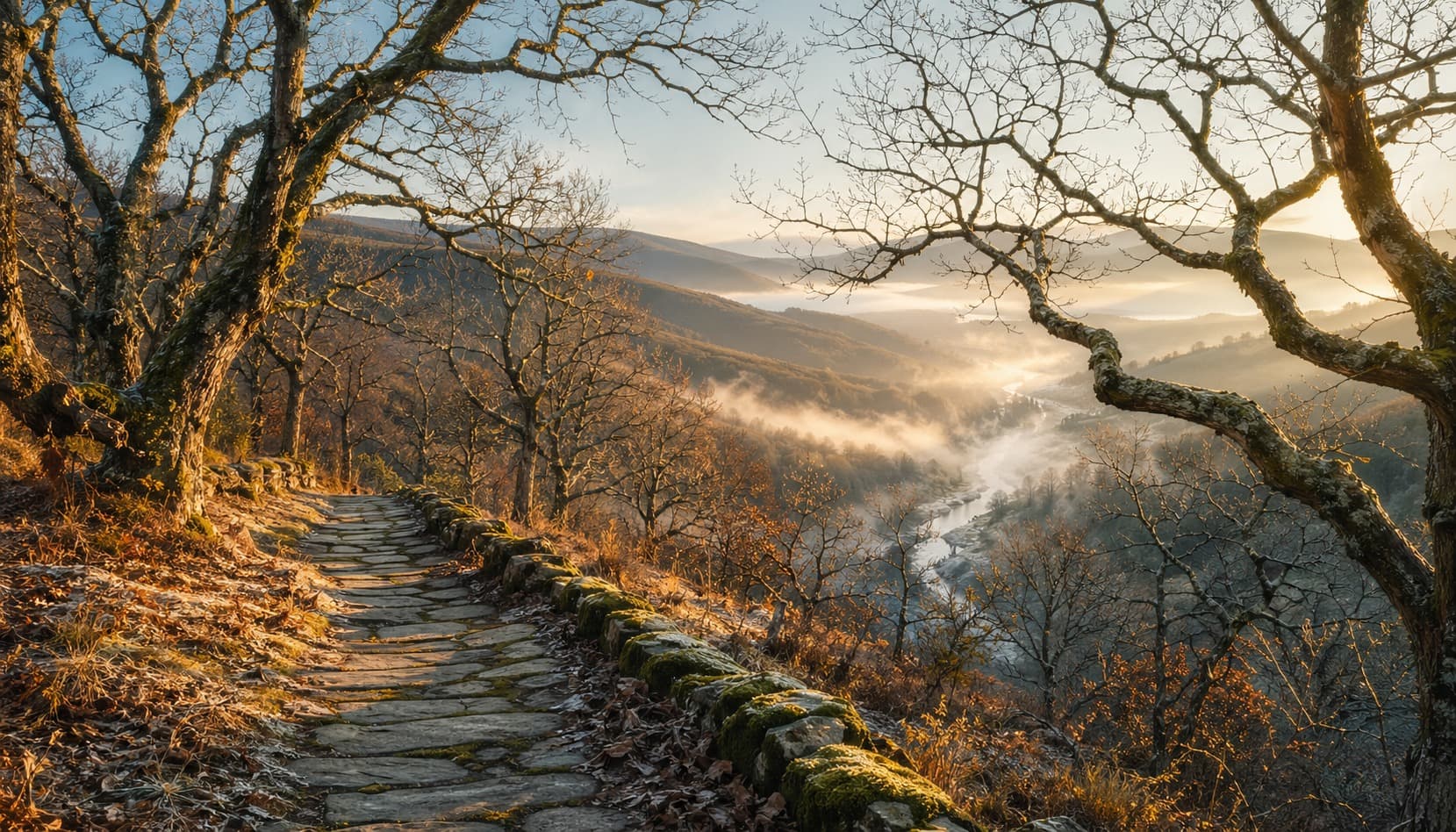
Camino de Invierno
263km pilgrimage route in Spain
Distance
263km
Duration
10 days
Difficulty
Moderate
Certification
Compostela
Start → End
Ponferrada → Santiago de Compostela
Planning Snapshot
Distance
263km
Typical duration
10 days
Average day
26.3km/day
Difficulty
Moderate
Best months
May–October
Lodging density
low
Resupply
moderate
Access
Bus or train to Ponferrada from León or Madrid, then onward local transport. Fly into León (LEN) or Madrid (MAD).
Is this route a good fit?
Best for
Wild Galicia & solitude
Time commitment
10 walking days at about 26.3km/day
Lodging and resupply
low lodging · moderate resupply
Why use Sacred Trails
Offline stages, waypoint stories, lodging notes, and route context stay available when mobile signal drops.
Rough Distance Planner
Use this as a rough distance sketch before detailed planning: 10 walking days across 263km, averaging about 26.3km per day. Adjust for real stages, terrain, rest days, weather, opening seasons, and lodging availability before booking.
Total days
10
Average walking day
26.3km
Route style
low lodging · moderate resupply
1
Walk
Ponferrada → Las Médulas
Ponferrada · 5 listed stays
26.3km
26.3km
2
Walk
Las Médulas → O Barco de Valdeorras
Puente de Domingo Flórez · 2 listed stays
26.3km
52.6km
3
Walk
O Barco de Valdeorras → A Pobra de Trives
Xagoaza · 1 listed stays
26.3km
78.9km
4
Walk
A Pobra de Trives → Castro Caldelas
A Pobra do Brollón · 1 listed stays
26.3km
105.2km
5
Walk
Castro Caldelas → Monforte de Lemos
Diomondi · 1 listed stays
26.3km
131.5km
6
Walk
Monforte de Lemos → Chantada
Rodeiro · 1 listed stays
26.3km
157.8km
7
Walk
Chantada → Rodeiro
Silleda · 4 listed stays
26.3km
184.1km
8
Walk
Rodeiro → Lalín
Dornelas · 1 listed stays
26.3km
210.4km
9
Walk
Lalín → Ponte Carreira
Outeiro (Vedra) · 1 listed stays
26.3km
236.7km
10
Walk
Ponte Carreira → Santiago de Compostela
Santiago de Compostela · 7 listed stays
26.3km
263km
Distances are averaged. Route markers use the nearest ordered waypoint to each rough segment; lodging references are supporting town data, not recommended overnight stops or confirmed availability.
About the Route
The Camino de Invierno — the Winter Way — was born out of necessity, carved by medieval pilgrims who dared not face the snow-choked passes of the Pyrenees in the coldest months. Branching south from Ponferrada, it winds through the forgotten heart of Galicia: the slate gorges of Quiroga, the vine-terraced valleys of Monforte de Lemos, and the mist-wrapped hills of Chantada. Far from the crowded Francés, this route offers an encounter with a wilder, quieter Spain — ancient stone bridges, abandoned monasteries, and the slow rhythm of a land that time has barely touched. Walking the Invierno is an act of solitude and surrender, tracing the footsteps of those who chose the harder road when all easier paths were closed.
Key Waypoints
Ponferrada
0km from start · 540mStarting point of the Camino de Invierno. Ponferrada is dominated by the formidable Templar Castle, built from 1178 by order of King Ferdinand II to protect pilgrims walking the Camino de Santiago. The Knights Templar held the fortress for over a century, and legend says a network of secret tunnels once connected it to Carracedo Monastery. Today pilgrims collect their credencial stamp here and gaze up at the golden towers before setting off through the El Bierzo valley.
Las Médulas
27.8km from start · 720mStamp available at the Las Médulas visitor centre, a UNESCO World Heritage Site since 1997. This astonishing landscape of red rock spires was created by the Romans using the ruina montium technique — hydraulic mining described by Pliny the Elder in 77 AD, in which vast quantities of water were channelled through 100 km of tunnels to blast entire mountains apart in search of gold. Pilgrims often pause at the Orellán viewpoint at dusk, when the cliffs turn blood-red — a sight that has stopped travellers for two thousand years.
A Rúa de Valdeorras
67km from start · 310mShort easy stage through the wine valley of Valdeorras. A Rúa is a tranquil riverside town in the Sil valley, surrounded by slate-roofed wine cellars and terraced vineyards. The Sil River flows gently through this valley, and the famous Valdeorras wine designation covers both whites from Godello and reds from Mencía. The old bridge and riverside walk make this a pleasant rest stop before the climb toward Quiroga.
Castro Caldelas
105km from start · 730mCastro Caldelas is a cliff-edge castle town at 730 metres whose fortifications were contested between the Counts of Lemos and the Bishops of Orense throughout the 14th and 15th centuries. The tower keep of the castle, built by the Count of Lemos in 1350, rises from naked granite above a 300-metre sheer drop into the Sil canyon. The Church of Santa María de Castro Caldelas preserves a rare Romanesque Virgin carved in the 12th century — one of the oldest sacred images in the Ribeira Sacra region. The town's position gives the first commanding views into the spectral terraced vineyards of the Cañón do Sil.
Sober
136km from start · 490mSober municipality contains some of the most extreme viticulture in the world — the so-called 'heroic vineyards' of the Ribeira Sacra, where monks from the Benedictine monastery of Santo Estevo de Ribas de Sil began cultivating grapes on terraces cut into near-vertical cliff faces as early as the 9th century AD. The gorge walls drop over 500 metres to the river below, and vineyards are still tended by hand and harvested into boats on the Sil. The Church of San Xoán de Loio in Sober dates to the 12th century and was a documented pilgrimage halt for monks crossing from the Ribeira Sacra to Santiago.
Rodeiro
184.8km from start · 630mRodeiro is a quiet rural municipality in the Galician interior, set among rolling hills and traditional stone farmhouses. The route climbs to its highest elevation in this section, offering sweeping views of the Galician countryside ahead. The Romanesque Church of Santa María de Rodeiro is a fine example of rural Galician religious architecture. Local hórreos (stone granaries) on stilts line the lanes. Stamp at the Church of Santa María or the local café.
Bandeira
224km from start · 430mBandeira sits at a crossroads in the Ulla valley where the medieval Camino de Invierno intersected with the north-south drovers' road (the Vía de la Plata branch connecting the Galician interior to the Rías Baixas markets). The 12th-century Church of San Xurxo de Bandeira preserves a carved Romanesque font and a tympanum of uncertain iconography that has fascinated scholars of pre-Romanesque Galician art. The Ulla River, whose headwaters originate in the hills to the east, already runs with some current here and was crossed by stone-paved fords that medieval livestock drovers shared with pilgrims.
Outeiro
246.3km from start · 260mThe stamp at Outeiro is available at the local bar-café or the small chapel of San Xoán, both recognised pilgrim stops on this penultimate stage before Santiago de Compostela. The village sits at the convergence of old livestock droving roads and the medieval pilgrim route, and its name — meaning 'small hill' in Galician — refers to the granite knoll that has served as a landmark for travellers for centuries. Stamping here is a moment of quiet celebration: the cathedral towers are less than 20 kilometres away.
25 waypoints total · Sacred Trails app contains full detail for every waypoint.
Points of Interest
Templar Castle of Ponferrada
· castleOne of the largest Templar fortresses in Spain, built in the 12th century. Houses the Templum Libri collection of rare religious manuscripts. The iconic starting landmark of the Camino de Invierno.
Iglesia de Santo Tomás de las Ollas
· church10th-century Mozarabic chapel on a hilltop outside Ponferrada. One of the finest examples of Mozarabic architecture in Spain, featuring a unique horseshoe-arch apse.
Las Médulas UNESCO Site
· monumentThe largest open-pit gold mine of the Roman Empire, designated a UNESCO World Heritage Site. The dramatic rust-red landscape of eroded rock pillars and chestnut forests is the highlight of stage 1.
Sil River Canyon Viewpoint
· viewpointStunning viewpoint overlooking the dramatic Sil River canyon between Quiroga and Monforte. The sheer rock walls and deep gorge carved by the Sil through the Ribeira Sacra are one of Spain's most spectacular natural landscapes.
Monastery of San Vicente do Pino
· monumentA Benedictine monastery dating to the 10th century, now converted into the Parador Nacional de Monforte de Lemos. Features a Renaissance façade, Gothic interior with elaborate vaults, and a Baroque organ. Crowns the hill above Monforte de Lemos.
Ribeira Sacra Wine Terraces
· viewpointThe dramatic terraced vineyards of the Ribeira Sacra, clinging almost vertically to the canyon walls above the Miño and Sil rivers. This DOC wine region produces exceptional Mencía red wines. Stage 7 passes through this spectacular landscape.
Accommodation
Town lodging summary
35 listed staysSantiago de Compostela
7 stays
Rates vary; record your own price notes.
Ponferrada
5 stays
Rates vary; record your own price notes.
Silleda
4 stays
Rates vary; record your own price notes.
Chantada
2 stays
Rates vary; record your own price notes.
Monforte de Lemos
2 stays
Rates vary; record your own price notes.
Puente de Domingo Flórez
2 stays
Rates vary; record your own price notes.
A Laxe (Bendoiro)
1 stay
Rates vary; record your own price notes.
A Pobra do Brollón
1 stay
Rates vary; record your own price notes.
Albergue parroquial San Nicolás de Flüe
Ponferrada
Rate varies
Albergue Alea
Ponferrada
Rate varies
Albergue Guiana
Ponferrada
Rate varies
Albergue Alda Pilgrim Ponferrada
Ponferrada
Rate varies
Albergue El Templarín
Ponferrada
Rate varies
Albergue municipal de Villavieja "Manuel Fuentes"
Villavieja
Rate varies
Albergue de peregrinos de Puente de Domingo Flórez
Puente de Domingo Flórez
Rate varies
Casa Rural El Refugio del Alquimista
Puente de Domingo Flórez
Rate varies
Camino / Gronze
Source reference
Camino accommodation entries are compiled from Gronze-oriented route research as planning references, not live inventory or an affiliated booking feed. Rates are traveler-owned notes because they change by season and operator; confirm availability directly before departure.
Showing 8 of 35 · Rates vary; use your own price notes and verify availability directly before your trip.
⚠️ Before You Go
Best avoid
December–February despite the "Winter" name — river stages flood after heavy rain
Weather risk
Rivers (Miño, Sil) can flood lower-stage paths in winter; fog in the Ribeira Sacra gorges
Mobile signal
Limited signal in the Ribeira Sacra river gorge section
Recommended to carry
Navigate the Camino de Invierno Offline
Stage-by-stage navigation, waypoint history, and lodging data — all offline in Sacred Trails. Free to download with route packs for the trails you walk.