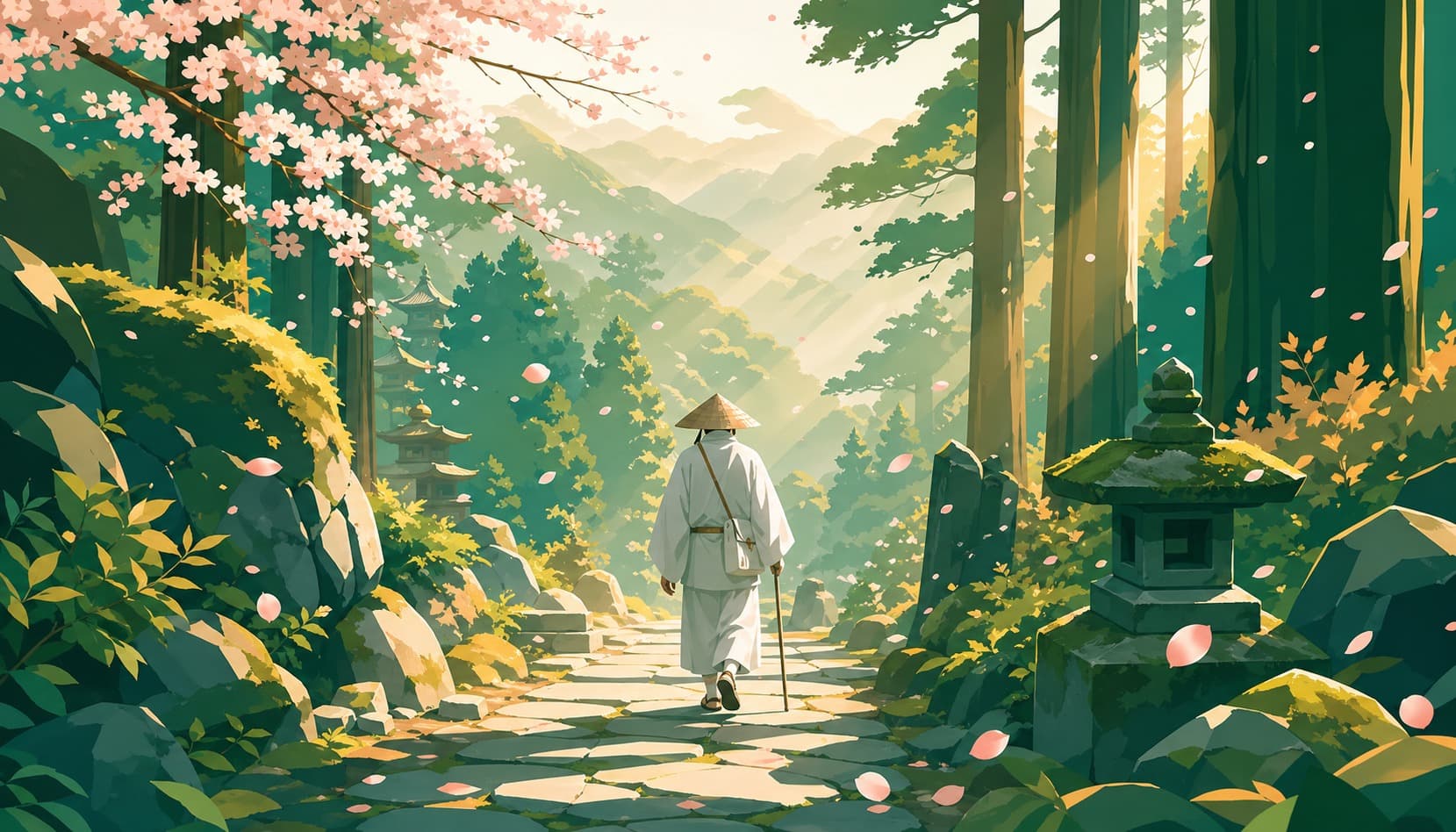
Shikoku 88 Temple Pilgrimage
1200km pilgrimage route in Japan
Distance
1200km
Duration
45 days
Difficulty
hard
Certification
Nōkyō-chō (納経帳)
Start → End
Ryōzen-ji → Ōkubo-ji
Planning Snapshot
Distance
1200km
Typical duration
45 days
Average day
26.7km/day
Difficulty
hard
Best months
March–May, September–November
Lodging density
medium
Resupply
moderate
Access
Fly into Matsuyama (MYJ) or Takamatsu (TAK). Ferries from Osaka/Kobe also reach Shikoku. Temple 1 (Ryōzen-ji) is near Tokushima.
Is this route a good fit?
Best for
Full pilgrimage circuit
Time commitment
45 walking days at about 26.7km/day
Lodging and resupply
medium lodging · moderate resupply
Why use Sacred Trails
Offline stages, waypoint stories, lodging notes, and route context stay available when mobile signal drops.
Rough Distance Planner
Use this as a rough distance sketch before detailed planning: 45 walking days across 1200km, averaging about 26.7km per day. Adjust for real stages, terrain, rest days, weather, opening seasons, and lodging availability before booking.
Total days
45
Average walking day
26.7km
Route style
medium lodging · moderate resupply
1
Walk
Ryōzen-ji → Jūraku-ji
Naruto · 2 listed stays
26.7km
26.7km
2
Walk
Jūraku-ji → Fujii-dera
Naruto · 2 listed stays
26.7km
53.4km
3
Walk
Fujii-dera → Onzan-ji
Kamiyama · 1 listed stays
26.7km
80.1km
4
Walk
Onzan-ji → Byōdō-ji
Kamiyama · 1 listed stays
26.7km
106.8km
5
Walk
Byōdō-ji
Kamiyama · 1 listed stays
26.7km
133.5km
6
Walk
Byōdō-ji → Yakuō-ji
Kamiyama · 1 listed stays
26.7km
160.2km
7
Walk
Yakuō-ji → Konomine-ji
Tokushima · 1 listed stays
26.7km
186.9km
8
Walk
Konomine-ji → Chikurin-ji
Tokushima · 1 listed stays
26.7km
213.6km
9
Walk
Chikurin-ji → Shōryū-ji
Tokushima · 1 listed stays
26.7km
240.3km
10
Walk
Shōryū-ji
Tokushima · 1 listed stays
26.7km
267km
11
Walk
Shōryū-ji → Zenraku-ji
Muroto · 1 listed stays
26.7km
293.7km
12
Walk
Zenraku-ji
Muroto · 1 listed stays
26.7km
320.4km
13
Walk
Zenraku-ji
Muroto · 1 listed stays
26.7km
347.1km
14
Walk
Zenraku-ji → Enkō-ji
Muroto · 1 listed stays
26.7km
373.8km
15
Walk
Enkō-ji → Ryūkō-ji
Kochi · 2 listed stays
26.7km
400.5km
16
Walk
Ryūkō-ji → Meiseki-ji
Kochi · 2 listed stays
26.7km
427.2km
17
Walk
Meiseki-ji → Iwamoto-ji
Kochi · 2 listed stays
26.6km
453.8km
18
Walk
Iwamoto-ji → Sairin-ji
Kochi · 2 listed stays
26.7km
480.5km
19
Walk
Sairin-ji → Enmei-ji
Shimanto · 1 listed stays
26.6km
507.1km
20
Walk
Enmei-ji → Kongōfuku-ji
Shimanto · 1 listed stays
26.7km
533.8km
21
Walk
Kongōfuku-ji → Sankaku-ji
Shimanto · 1 listed stays
26.6km
560.4km
22
Walk
Sankaku-ji → Kannon-ji (Kanonji)
Shimanto · 1 listed stays
26.7km
587.1km
23
Walk
Kannon-ji (Kanonji) → Dōryū-ji
Tosashimizu · 1 listed stays
26.6km
613.7km
24
Walk
Dōryū-ji → Negoro-ji
Tosashimizu · 1 listed stays
26.7km
640.4km
25
Walk
Negoro-ji → Nagao-ji
Tosashimizu · 1 listed stays
26.6km
667km
26
Walk
Nagao-ji
Tosashimizu · 1 listed stays
26.7km
693.7km
27
Walk
Nagao-ji → Ishite-ji
Kuma · 1 listed stays
26.6km
720.3km
28
Walk
Ishite-ji
Kuma · 1 listed stays
26.7km
747km
29
Walk
Ishite-ji
Kuma · 1 listed stays
26.6km
773.6km
30
Walk
Ishite-ji → Yokomine-ji
Kuma · 1 listed stays
26.7km
800.3km
31
Walk
Yokomine-ji → Kōon-ji
Kuma · 1 listed stays
26.6km
826.9km
32
Walk
Kōon-ji
Matsuyama · 2 listed stays
26.7km
853.6km
33
Walk
Kōon-ji → Unpen-ji
Matsuyama · 2 listed stays
26.6km
880.2km
34
Walk
Unpen-ji
Matsuyama · 2 listed stays
26.6km
906.8km
35
Walk
Unpen-ji
Mitoyo · 1 listed stays
26.7km
933.5km
36
Walk
Unpen-ji → Zentsu-ji
Mitoyo · 1 listed stays
26.7km
960.2km
37
Walk
Zentsu-ji
Mitoyo · 1 listed stays
26.6km
986.8km
38
Walk
Zentsu-ji
Mitoyo · 1 listed stays
26.7km
1013.5km
39
Walk
Zentsu-ji
Zentsuji · 1 listed stays
26.6km
1040.1km
40
Walk
Zentsu-ji → Ichinomiya-ji
Zentsuji · 1 listed stays
26.7km
1066.8km
41
Walk
Ichinomiya-ji
Zentsuji · 1 listed stays
26.6km
1093.4km
42
Walk
Ichinomiya-ji
Zentsuji · 1 listed stays
26.6km
1120km
43
Walk
Ichinomiya-ji → Yakuri-ji
Sanuki · 1 listed stays
26.7km
1146.7km
44
Walk
Yakuri-ji
Sanuki · 1 listed stays
26.6km
1173.3km
45
Walk
Yakuri-ji → Ōkubo-ji
Sanuki · 1 listed stays
26.7km
1200km
Distances are averaged. Route markers use the nearest ordered waypoint to each rough segment; lodging references are supporting town data, not recommended overnight stops or confirmed availability.
Four Prefectures, Four Dōjō
The 88-temple circuit is divided into four sections — one per prefecture — each with a distinct character and spiritual theme.
Awa (阿波)
Temples 1–23Tokushima · Difficulty ★★★★☆
“Where mountains swallow the path and silence becomes the teacher”
- ·Dawn bells at Temple 1 drift in with sea breeze from Naruto Strait
- ·Ancient cedar forests canopy the trail between temples 11–12
- ·Night walking by lantern light to Temple 21 on Mt. Tairyu
Tosa (土佐)
Temples 24–39Kochi · Difficulty ★★★☆☆
“The Pacific opens to your left and the sky has no ceiling”
- ·Temple 24 perches on a cliff where the Pacific stretches to the horizon
- ·Katsurahama beach — black sand, crashing waves, and solitude between temples
- ·Ryugado cave near temple 31: limestone stalactites formed over 100,000 years
Iyo (伊予)
Temples 40–65Ehime · Difficulty ★★☆☆☆
“Citrus groves and thermal springs — the body heals while the mind wanders”
- ·Dōgo Onsen, 3,000 years old, reportedly where the gods bathe
- ·Mt. Ishizuchi (1,982m) — Shikoku's highest peak, visible from the trail
- ·Temple 45: cedar trees over 800 years old line the stone-paved approach
Sanuki (讃岐)
Temples 66–88Kagawa · Difficulty ★★☆☆☆
“The end of the circle is also its beginning — Kōbō Daishi was born here”
- ·Zentsūji (Temple 75): pilgrims walk a pitch-black corridor holding a golden rope to Daishi's hand
- ·Naoshima island — contemporary art pavilions hidden among traditional fishing villages
- ·Final bell at Ōkubo-ji (Temple 88): many pilgrims weep as the circle closes
About the Route
The Shikoku Henro is a 1,200-kilometer circuit of 88 temples encircling the island of Shikoku, birthplace of Kōbō Daishi — the monk who carried Buddhism's esoteric flame from Tang-dynasty China and founded Shingon, reshaping the spiritual landscape of Japan forever. Pilgrims dress in white, the color of death and rebirth, and carry a wooden staff said to embody Kōbō Daishi himself, for the ancient teaching of Dōgyō Ninin — "two walking together" — holds that the great master never abandons those who walk his path. The four prefectures of the island form a sacred geography of the soul: Awakening, Discipline, Enlightenment, and Nirvana, each stage unfolding across cliffs above the Pacific, cedar-shadowed mountain passes, and quiet riverside temples where incense has burned for a thousand years. Pilgrims complete the circuit in many ways — some in white linen on foot over 60 days, others by bus in a fortnight — yet all arrive at the same truth: that to walk Shikoku is to walk in the footsteps of eternity.
Key Waypoints
Ryōzen-ji
0km from start · 20mFirst temple of the Shikoku Henro and the starting point of 'Hosshin' — the awakening of the pilgrim's resolve. Legend holds that Kukai (Kobo Daishi), born as Saeki no Mao, trained in this region before crossing to Tang China. Upon his return he founded the temple in the image of India's sacred Vulture Peak. Pilgrims traditionally outfit themselves here with the white robe, sedge-grass hat, and staff — symbolizing readiness to walk 'with Daishi' as two companions. The Niomon gate, evoking an Indian aesthetic, marks the solemn threshold. Two stamps are collected: main hall and Daishi hall.
Dainichi-ji (Handa)
67km from start · 70mSeated quietly among rice fields along the Yoshino River, this temple enshrines Dainichi Nyorai. A stone Yakushi Nyorai said to have been carved overnight by Kobo Daishi remains in the precinct. One of the smaller, more intimate stops on the Tokushima circuit. Two stamps.
Yakuō-ji
164km from start · 60mLast temple of Tokushima and one of Japan's foremost sites for warding off misfortune. An ancient custom dating to the Edo period has visitors in their yakudoshi (unlucky years — ages 25 and 42 for men, 19 and 33 for women) place one-yen coins on each stone step as they ascend, symbolically shedding ill fortune with every step. The Yugitō five-story pagoda against a backdrop of the sea at dusk is the temple's iconic image. Kobo Daishi is said to have performed purification rites here personally, earning the temple's reverence as 'Yakuyoke Daishi'. Pilgrims completing the Tokushima circuit feel the weight of the province's mountains lifting as the ocean comes into view.
Kiyotaki-ji
228km from start · 130mNamed for the sacred waterfall on its grounds, this temple carries a living tradition of healing and purification rooted in the flowing waters that give it its identity. Climbing 110 stone steps, pilgrims are greeted by a towering 15-metre standing statue of Yakushi Nyorai, the healing Buddha, visible from well beyond the temple grounds. Two stamps.
Sairin-ji
481km from start · 58mLegend holds that Kobo Daishi encountered a disabled man who had traveled from the distant province of Harima, and healed his legs using water drawn from a sacred well within the temple grounds. That well still flows today, and pilgrims with ailments of the knees and legs continue to drink from it in the hope of healing, earning the temple the nickname 'Iyo's Knees.' Two stamps.
Kongōfuku-ji
531km from start · 80mThe southernmost temple on all of Shikoku, perched on the dramatic cliffs of Cape Ashizuri where Kobo Daishi is said to have gazed out to sea contemplating the paradise of Fudaraku beyond the horizon. Ancient local fishermen believed that when whales surfaced near the cape, it was a sign of Daishi's divine messenger. The 85-kilometre stretch from Temple 37 is the longest temple-to-temple gap in the entire pilgrimage; pilgrims arriving here after days of coastal walking feel an immense release. Subtropical Livistona palms fill the precinct with a tropical mood. The principal image is a Three-Faced Thousand-Armed Kannon, and dawn worship is considered especially auspicious. Stamp at the temple office.
Shusshaka-ji
602km from start · 235mAccording to tradition, Kobo Daishi came to this cliff at age seven and threw himself off, declaring that if the Buddha did not want him to pursue the dharma, he was ready to die. He was caught by celestial beings and Shakyamuni himself. The cliff where this happened — Shashin-ga-take — rises directly behind the main hall, and pilgrims who climb it stand at the exact point of a seven-year-old's absolute conviction.
Yashima-ji
651km from start · 295mYashima-ji stands on the plateau where the sea battle of Yashima was fought in 1185 — the battle where the young archer Nasu no Yoichi shot an arrow from a rocking boat and struck a fan mounted on the enemy's ship, one of Japanese literature's most celebrated feats of precision. The Seto Inland Sea spreads below unchanged. Here, Buddhist sanctuary and the memory of warfare occupy the same ground without apparent contradiction.
88 waypoints total · Sacred Trails app contains full detail for every waypoint.
Points of Interest
Ryōzen-ji (Temple 1)
· templeStarting point of the Shikoku Henro. Pilgrimage supplies (white coat, walking staff, sedge hat) can be purchased here. Open 6:00–17:00.
Naruto Whirlpools
· viewpointWorld-class whirlpools in the Naruto Strait. Close to Temple 1 Ryozenji. Viewable from the Uzuno-michi walkway below the Onaruto Bridge. Best viewed at spring tides.
Cape Muroto (Kobo Daishi Enlightenment Site)
· monumentSite of the Mikurodo cave where young Kukai (Kobo Daishi) meditated and attained enlightenment. Cape Muroto is Shikoku's southeastern tip with spectacular ocean views.
Cape Muroto Lighthouse
· landmarkWhite lighthouse built in 1899, standing at the very tip of Cape Muroto. Offers panoramic views of the Pacific Ocean. A short walk from the henro trail near Temple 24 Higashidera.
Katsurahama Beach
· viewpointKochi's most famous scenic beach, renowned for moon-viewing. A large bronze statue of Sakamoto Ryoma gazes out to sea. Scenic stop near Temple 30. Known for its pine-lined crescent shore.
Kochi Castle
· monumentOne of Japan's 12 original surviving castles. Close to Temple 30 Zenrakuji and a major Kochi sightseeing spot. Retains its original Edo-period appearance.
Accommodation
Town lodging summary
15 listed staysKochi
2 stays
Rates vary; record your own price notes.
Matsuyama
2 stays
Rates vary; record your own price notes.
Naruto
2 stays
Rates vary; record your own price notes.
Kamiyama
1 stay
Rates vary; record your own price notes.
Kuma
1 stay
Rates vary; record your own price notes.
Mitoyo
1 stay
Rates vary; record your own price notes.
Muroto
1 stay
Rates vary; record your own price notes.
Sanuki
1 stay
Rates vary; record your own price notes.
宿坊 霊山寺(第1番)
Naruto
Rate varies
30 beds
善根宿 遍路の宿 なると
Naruto
Rate varies
6 beds
民宿 徳増(焼山寺登山口)
Kamiyama
Rate varies
15 beds
宿坊 大日寺(第13番)
Tokushima
Rate varies
20 beds
民宿 室戸荘(室戸岬)
Muroto
Rate varies
18 beds
善根宿 土佐のへんろ小屋
Kochi
Rate varies
8 beds
遍路宿 岩本寺前(第37番)民宿 まえだ
Shimanto
Rate varies
12 beds
民宿 足摺黒潮(足摺岬)
Tosashimizu
Rate varies
20 beds
Manual route notes
Verify directly
This route uses manually maintained lodging notes or bundled app data. Treat the list as a pre-trip starting point, not live inventory, and verify each stay directly before building an itinerary.
Showing 8 of 15 · Rates vary; use your own price notes and verify availability directly before your trip.
⚠️ Before You Go
Best avoid
June–July (tsuyu rainy season) and August (extreme heat in Kochi prefecture)
Weather risk
Tsuyu rain June–July; summer heat in Kochi (high 30s°C); typhoons August–September
Mobile signal
Remote mountain sections between Temples 12–23 (Tosa) have minimal signal
Cash
Many temples and rural lodgings only accept cash — carry ¥20,000+ at all times
Note
The full 1,200 km circuit takes 30–60 days on foot; Temple 66 (Unpen-ji) and the Tosa coastal stages are the most demanding
Recommended to carry
Navigate the Shikoku 88 Temple Pilgrimage Offline
Stage-by-stage navigation, waypoint history, and lodging data — all offline in Sacred Trails. Free to download with route packs for the trails you walk.