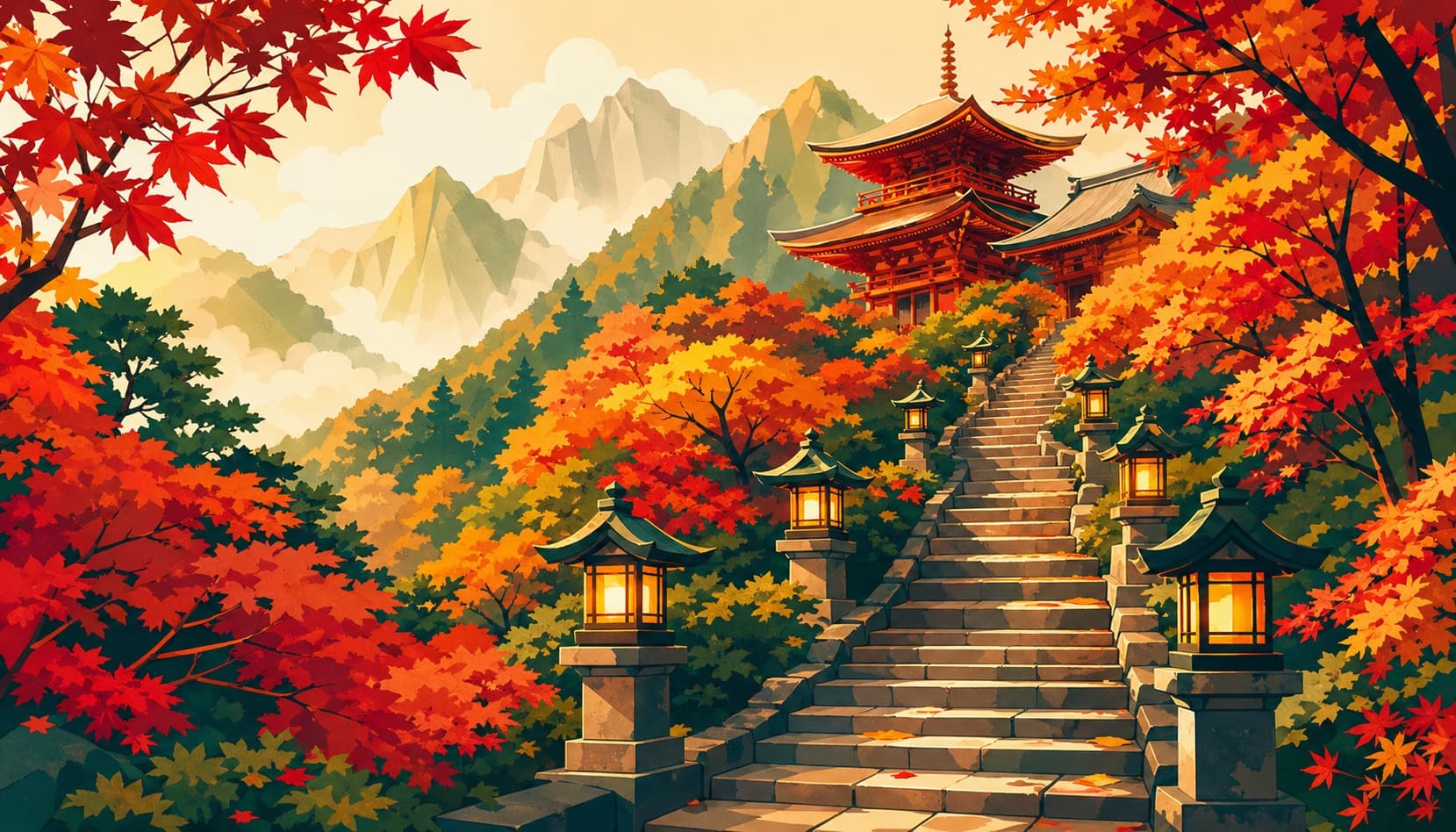
Saigoku 33 Kannon Pilgrimage
1000km pilgrimage route in Japan
Distance
1000km
Duration
30 days
Difficulty
Moderate
Certification
Nōkyō-chō (納経帳)
Start → End
Seiganto-ji → Kegonji (Tanigumi-san)
Planning Snapshot
Distance
1000km
Typical duration
30 days
Average day
33.3km/day
Difficulty
Moderate
Best months
March–May, October–November
Lodging density
high
Resupply
easy
Access
Fly into Osaka (KIX or ITM) or Kyoto (via Osaka). Shinkansen + local trains connect all 33 temple areas across Kansai.
Is this route a good fit?
Best for
Urban convenience & temples
Time commitment
30 walking days at about 33.3km/day
Lodging and resupply
high lodging · easy resupply
Why use Sacred Trails
Offline stages, waypoint stories, lodging notes, and route context stay available when mobile signal drops.
Rough Distance Planner
Use this as a rough distance sketch before detailed planning: 30 walking days across 1000km, averaging about 33.3km per day. Adjust for real stages, terrain, rest days, weather, opening seasons, and lodging availability before booking.
Total days
30
Average walking day
33.3km
Route style
high lodging · easy resupply
1
Walk
Seiganto-ji → Kimii-dera
Nachikatsuura · 2 listed stays
33.3km
33.3km
2
Walk
Kimii-dera
Nachikatsuura · 2 listed stays
33.3km
66.6km
3
Walk
Kimii-dera → Kokawa-dera
Nachikatsuura · 2 listed stays
33.3km
99.9km
4
Walk
Kokawa-dera → Seifuku-ji
Sakurai · 1 listed stays
33.3km
133.2km
5
Walk
Seifuku-ji
Sakurai · 1 listed stays
33.3km
166.5km
6
Walk
Seifuku-ji → Fujii-dera
Sakurai · 1 listed stays
33.3km
199.8km
7
Walk
Fujii-dera → Tsubosaka-dera
Sakurai · 1 listed stays
33.3km
233.1km
8
Walk
Tsubosaka-dera → Oka-dera (Ryugai-ji)
Nara · 1 listed stays
33.3km
266.4km
9
Walk
Oka-dera (Ryugai-ji) → Hase-dera
Nara · 1 listed stays
33.3km
299.7km
10
Walk
Hase-dera → Kofuku-ji (Nan-en-do)
Nara · 1 listed stays
33.3km
333km
11
Walk
Kofuku-ji (Nan-en-do) → Mimuroto-ji
Nara · 1 listed stays
33.4km
366.4km
12
Walk
Mimuroto-ji
Kyoto · 2 listed stays
33.3km
399.7km
13
Walk
Mimuroto-ji → Daigo-ji (Kami-Daigo)
Kyoto · 2 listed stays
33.3km
433km
14
Walk
Daigo-ji (Kami-Daigo) → Mii-dera (Onjo-ji)
Kyoto · 2 listed stays
33.4km
466.4km
15
Walk
Mii-dera (Onjo-ji) → Gyogan-ji (Kodo)
Kyoto · 2 listed stays
33.4km
499.8km
16
Walk
Gyogan-ji (Kodo) → Yoshimine-dera
Takarazuka · 1 listed stays
33.3km
533.1km
17
Walk
Yoshimine-dera → Anao-ji
Takarazuka · 1 listed stays
33.4km
566.5km
18
Walk
Anao-ji → Katsuo-ji
Takarazuka · 1 listed stays
33.3km
599.8km
19
Walk
Katsuo-ji → Nakayama-dera
Takarazuka · 1 listed stays
33.4km
633.2km
20
Walk
Nakayama-dera → Banshu Kiyomizu-dera
Himeji · 1 listed stays
33.3km
666.5km
21
Walk
Banshu Kiyomizu-dera
Himeji · 1 listed stays
33.4km
699.9km
22
Walk
Banshu Kiyomizu-dera → Ichijo-ji
Himeji · 1 listed stays
33.3km
733.2km
23
Walk
Ichijo-ji
Himeji · 1 listed stays
33.3km
766.5km
24
Walk
Ichijo-ji → Nariai-dera
Omihachiman · 1 listed stays
33.4km
799.9km
25
Walk
Nariai-dera → Matsuo-dera
Omihachiman · 1 listed stays
33.4km
833.3km
26
Walk
Matsuo-dera → Hogon-ji
Omihachiman · 1 listed stays
33.3km
866.6km
27
Walk
Hogon-ji → Kannonsho-ji
Omihachiman · 1 listed stays
33.3km
899.9km
28
Walk
Kannonsho-ji
Ibigawa · 1 listed stays
33.4km
933.3km
29
Walk
Kannonsho-ji
Ibigawa · 1 listed stays
33.4km
966.7km
30
Walk
Kannonsho-ji → Kegonji (Tanigumi-san)
Ibigawa · 1 listed stays
33.3km
1000km
Distances are averaged. Route markers use the nearest ordered waypoint to each rough segment; lodging references are supporting town data, not recommended overnight stops or confirmed availability.
Seven Prefectures, One Ancient Circuit
Japan's oldest pilgrimage (718 CE) spans Wakayama, Osaka, Nara, Kyoto, Hyogo, Shiga, and Gifu — each region with distinct character and temple styles.
Wakayama — The Sacred Origin
Temples 1–3“Where the pilgrimage begins — Nachi Falls, one of Japan's tallest, roars beside Temple 1”
- ·Nachi Falls (133m) beside Temple 1 — the tallest single-drop falls in Japan
- ·Kumano Nachi Taisha shrine adjacent — collect both a temple and a shrine seal
- ·Remote location means few crowds; the sea of trees around Nachi is ancient cedar
Osaka & Nara — Ancient Capitals
Temples 4–9“Japan's oldest temples and the deer-filled ancient capital of Nara”
- ·Temple 8 (Hase-dera): 400 stone-lantern steps lead to the cliff-face main hall
- ·Nara Park: free-roaming sacred deer surround the route between temples
- ·Temple 4 (Seigai-ji) on Mt. Kongo — remote mountain approach
Kyoto — City of a Thousand Temples
Temples 10–22“The emotional heart of the pilgrimage — eleven temples spread across Japan's cultural capital”
- ·Kiyomizu-dera (Temple 16): the wooden stage cantilevered 13m over a forested cliff
- ·Rokkaku-do (Temple 18): birthplace of Ikebana (flower arranging), 1,500 years old
- ·Temple 17 (Rokuhara Mitsu-ji): displays death masks of famous warlords
Hyogo, Shiga & Gifu — The Final Arc
Temples 24–33“Lake Biwa's sacred shores and the final temple 1,000km from where it all began”
- ·Temple 30 (Chikubu-shima): only accessible by boat, on an island in Lake Biwa
- ·Lake Biwa sunset views from temples 31–32 hillside paths
- ·Kegon-ji (Temple 33): ancient cedar avenue leads to the last stamp — the pilgrimage complete
About the Route
Japan's oldest pilgrimage, the Saigoku 33 Kannon circuit stretches over 1,000 kilometers across six prefectures of the ancient Kansai heartland, weaving together sacred waterfalls, mountain temples, and imperial capitals in a single unbroken thread of devotion. The route was reborn in the 10th century when Emperor Kazan, having renounced his throne, wandered the Kinki region in white robes to revive a pilgrimage said to have been ordained by Kannon herself over 1,300 years ago. Pilgrims carry the nōkyō-chō, a book of calligraphic seals stamped at each of the 33 temples dedicated to Kannon, the Bodhisattva of Infinite Compassion, collecting not merely ink but the accumulated grace of every soul who walked before them. From the thundering curtain of Nachi Falls at Temple One to the mist-shrouded peaks above Kyoto, this Japan Heritage pilgrimage remains a living conversation between the Japan of ancient emperors and the seekers of every age.
Key Waypoints
Seiganto-ji
0km from start · 250mFirst temple of the Saigoku circuit, perched above the 133-metre Nachi Falls — Japan's tallest single-drop waterfall — beside the UNESCO World Heritage Nachi Grand Shrine. The 10th-century Emperor Kazan, having abdicated to become a monk, is credited with reviving and codifying the 33-temple Saigoku pilgrimage after years of wandering the Kinki region. The iconic view framing the three-storey pagoda, main hall, and Nachi Falls together is among Japan's most recognized landscapes. The falls themselves are a Shinto deity, worshipped by Shugendo mountain ascetics who perform waterfall austerities here. Stamp at the main hall; many pilgrims also collect the Nachi Shrine seal next door.
Fujii-dera
200km from start · 15mFifth temple of Saigoku, a quiet Shingon sanctuary set amid the urban sprawl of southern Osaka. The principal image — a Thousand-Armed Kannon designated a National Treasure — is exceptional even among Kannon sculptures: carved in the 8th-century Tenpyo period, it possesses 1,007 actual arms, the highest number of any surviving Senju Kannon in Japan. The temple is attributed to the monk Gyoki, who founded it in 724, with later involvement by Kobo Daishi. The modern city of Fujiidera takes its name entirely from this temple. Stamp at the main hall.
Kofuku-ji (Nan-en-do)
320km from start · 95mNinth temple of Saigoku, housed in the octagonal Nan-en-do hall of the UNESCO World Heritage Kofuku-ji — the great clan temple of the Fujiwara, who dominated Japanese court politics for centuries. The hall was built in 721 by Fuhito's son Fusasaki to pray for his father's soul. The principal image, Fukukensaku Kannon, is an absolute secret Buddha unveiled only once a year on October 17th. A legend of Fuhito receiving a dream oracle from a 'White-Headed Elder' regarding Kannon's blessings gave rise to a faith tradition of praying here for recovery from eye ailments. The freely wandering deer of Nara Park, considered sacred messengers of the Kasuga Grand Shrine since antiquity, add an ethereal atmosphere to morning visits. Stamp at the temple office.
Ishiyama-dera
460km from start · 55mThirteenth temple of Saigoku, built atop a natural outcrop of wollastonite beside the Seta River. Famed as the place where Murasaki Shikibu conceived The Tale of Genji; her writing room survives on the grounds. Renowned for autumn foliage and moon-viewing. Stamp at the main hall.
Choho-ji (Rokkaku-do)
487km from start · 40mEighteenth temple of Saigoku, the hexagonal Rokkaku-do (Six-Cornered Hall) in the heart of Kyoto. Prince Shotoku is said to have carved its principal Nyoirin Kannon himself; arriving here to gather timber for Shitennoji temple, he bathed in the sacred pond and received a divine dream, founding a hermitage on the spot. The name 'Ikenobo' derives from a monk's cell beside the temple pond — it was from this cell in the Muromachi period that the monk Senkei is said to have originated ikebana (flower arranging), and the Ikenobo school of ikebana continues here today. A stone marking Kyoto's geographical center ('navel stone') sits in the precinct. Doves gather in large numbers, lending the compact courtyard a serene urban calm. Stamp at the main hall.
Anao-ji
570km from start · 70mTwenty-first temple of Saigoku, a quiet ancient temple in the rural Kameoka basin. The main hall's 'surrogate Shakyamuni Nirvana' statue lies hidden under a quilt; worshippers rub the corresponding body part of the statue to pray for healing — a beloved tradition. Stamp at the main hall.
Banshu Kiyomizu-dera
690km from start · 500mTwenty-fifth temple of Saigoku, the 'Other Kiyomizu' — a mountain temple in Harima (Hyogo) distinct from the Kyoto namesake. The founding legend is extraordinary: the temple was opened by Hodo Sennin, a legendary ascetic said to have come from India, during the reign of Empress Suiko (7th century), with later involvement by the monk Gyoki and the founding Tendai patriarch Saicho. An ancient well in the precinct, the 'Okage no Ido', is said to reflect one's past, present, and future to those who gaze into it. The mountain summit at 500 metres commands sweeping views over the mountains of Harima and Tajima, with outstanding spring greenery and autumn colour. Stamp at the main hall.
Matsuo-dera
830km from start · 270mTwenty-ninth temple of Saigoku, nestled in cedar forests of Mount Matsuo. Founded by the Tang monk Ikko in 720, enshrining a Bato (Horse-Headed) Kannon as principal image — venerated for traffic safety and protection of horses. Stamp at the main hall.
33 waypoints total · Sacred Trails app contains full detail for every waypoint.
Points of Interest
Nachi Falls
· waterfallJapan's tallest waterfall at 133 meters. Part of the UNESCO World Heritage 'Sacred Sites and Pilgrimage Routes in the Kii Mountain Range'. An iconic symbol of Kumano alongside Seiganto-ji.
Kumano Kodo - Ohechi Trail
· viewpointThe Ohechi section of the Kumano Kodo ancient pilgrimage road near Nachi. UNESCO World Heritage listed, connecting to Seiganto-ji. A coastal trail with dramatic Pacific Ocean views.
Wakayama Castle
· monumentHilltop castle of the Kishu Tokugawa clan, with a striking white keep atop Torafusu-yama. About 20km from Temple 2 Kimii-dera. Central tourist attraction of Wakayama city.
Yoshino Mountain (Cherry Blossom Sacred Site)
· viewpointJapan's most celebrated cherry blossom site, with ~30,000 trees blanketing the mountainside. UNESCO World Heritage listed as part of the Kii Mountain Range. Also a sacred Shugendo site centered on Kinpusen-ji.
Todai-ji Great Buddha Hall
· monumentHouses a 14.98-meter bronze Great Buddha (Vairocana) in the world's largest wooden structure. UNESCO World Heritage at the heart of historic Nara. A must-visit near Temples 8–9 in the Nara cluster.
Nara Park Sacred Deer
· viewpointAround 1,200 free-roaming wild deer, considered messengers of Kasuga Grand Shrine. Designated as national natural monuments, famously known for begging tourists for deer crackers.
Accommodation
Town lodging summary
10 listed staysKyoto
2 stays
Rates vary; record your own price notes.
Nachikatsuura
2 stays
Rates vary; record your own price notes.
Himeji
1 stay
Rates vary; record your own price notes.
Ibigawa
1 stay
Rates vary; record your own price notes.
Nara
1 stay
Rates vary; record your own price notes.
Omihachiman
1 stay
Rates vary; record your own price notes.
Sakurai
1 stay
Rates vary; record your own price notes.
Takarazuka
1 stay
Rates vary; record your own price notes.
那智山 青岸渡寺 宿坊
Nachikatsuura
Rate varies
30 beds
那智勝浦 ホテル浦島
Nachikatsuura
Rate varies
500 beds
長谷寺 宿坊 長谷路
Sakurai
Rate varies
40 beds
奈良 ゲストハウス もちいどの
Nara
Rate varies
20 beds
京都 清水寺近くの宿 旅籠屋
Kyoto
Rate varies
50 beds
善峯寺 山荘 西山いこいの家
Kyoto
Rate varies
25 beds
中山寺 参拝宿坊
Takarazuka
Rate varies
20 beds
姫路 グリーンホテル
Himeji
Rate varies
120 beds
Manual route notes
Verify directly
This route uses manually maintained lodging notes or bundled app data. Treat the list as a pre-trip starting point, not live inventory, and verify each stay directly before building an itinerary.
Showing 8 of 10 · Rates vary; use your own price notes and verify availability directly before your trip.
⚠️ Before You Go
Best avoid
August (heat and humidity across all seven prefectures)
Weather risk
Snow possible Dec–Feb at higher temples (Nakayama-dera area, Tamba plateaus); summer heat warnings in Wakayama
Mobile signal
Mountain temple access roads can be closed after heavy snow in winter
Cash
Temple stamp offices (nōkyōsho) require cash payment (¥300 per stamp); carry ¥5,000+ at all times
Note
Unlike henro routes, Saigoku temples are spread across 7 prefectures and require transit between sites — most pilgrims use a combination of walking and public transport
Recommended to carry
Navigate the Saigoku 33 Kannon Pilgrimage Offline
Stage-by-stage navigation, waypoint history, and lodging data — all offline in Sacred Trails. Free to download with route packs for the trails you walk.